
What Is Embodied Creativity (And Why Does It Matter for Your Mental Health)?
There is a kind of creativity that helps us tune in.
I first began to understand this not in a studio, but in a classroom. During my training as an art therapist, I worked with high-need children in Surrey, British Columbia, children who had experienced trauma, loss, and chronic instability. What I witnessed in those sessions was how the simple act of making something with their hands could shift a child’s nervous system and affect. The room would quiet. The body would settle. Something that had no words would begin to find a shape.
I carried that understanding home with me. And then, during a season of my own life when my mind felt relentlessly loud, I found my way to a pottery wheel. There was something about working with clay, the weight of it, the way it demanded my full attention, the texture of it in my hands, that did something nothing else could quite reach. It quieted me. It brought me back into my body at a time when I deeply needed to land somewhere.
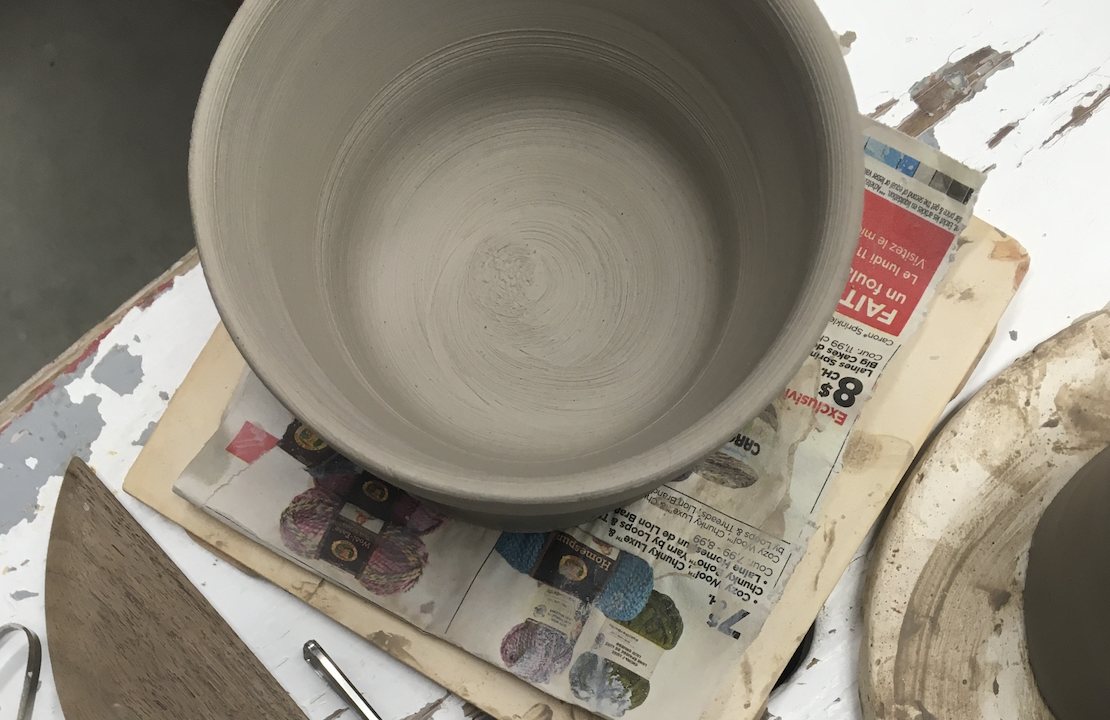
Throwing on the pottery wheel: my first bowl from my very first pottery class
That is when I understood embodied creativity from the inside.
Not in the polished idea, the finished painting, or the perfectly composed journal entry. But in the breath that slows when your hands are finally doing something that has nothing to do with a screen, a to-do list, or anyone else's needs. In the way your shoulders drop when colour meets paper. In the quiet that settles, unexpectedly, in the middle of making something.
This is embodied creativity. And if you have ever felt more like yourself after making something, even something small and imperfect and entirely for your eyes only, you have already experienced it.
What Does "Embodied" Actually Mean?
The word "embodied" gets used a lot in wellness spaces, sometimes so loosely it starts to lose its meaning. So let's be specific.
To be embodied is to be present in your body, not just in your mind. It means your awareness has dropped below the endless loop of thoughts and arrived somewhere more immediate: the weight of your hands, the rhythm of your breath, the sensory experience of being a body in a moment.
For many of us, this is harder than it sounds. We live in our heads. We plan, analyse, replay, anticipate. The body becomes something we manage or push through rather than something we actually inhabit.
Somatic therapists and trauma researchers like Peter Levine and Bessel van der Kolk have written extensively about how disconnection from the body is often at the root of anxiety, chronic stress, and the lasting effects of trauma. Van der Kolk's foundational work reminds us that the body holds our experiences, including the ones we never found words for. Levine's research on somatic experiencing points to the body's innate capacity for healing, when given the right conditions.
Embodied creativity invites those conditions in through the side door.
How Art-Making Brings You Back Into Your Body
When you engage in a creative practice without pressure or outcome, something shifts.
Your nervous system responds to the slow, rhythmic quality of mark-making. Drawing, painting, collaging, sculpting with clay, these activities engage your hands, your senses, and your attention in a way that gently pulls awareness out of the thinking mind and into the present moment.
This is not metaphor. It is physiology.
Research on the body's stress response shows that slow, repetitive sensorimotor activities can activate the parasympathetic nervous system (the branch responsible for rest, repair, and a felt sense of safety). Art-making can be one of these activities, not because it is inherently calming, but because it invites the kind of focused, sensory presence that helps support the nervous system from the inside out.
Expressive arts therapists have long understood this. When a person engages in the tactile, kinesthetic experience of making something, they are not just producing art, they are processing. Moving energy through the body. Giving form to something that was previously formless.
And sometimes, the most honest thing inside us can only find its way out through colour, texture, or movement, not through words.
Embodied Creativity Is Not About Making Good Art
Here is where embodied creativity parts ways with most of what we have been taught about art.
Most of us grew up receiving one of two messages: either you are creative, or you are not. Art was something you were assessed on, compared in, or told was not really your thing. That story does not go away easily.
But embodied creativity doesn’t care about any of that.
When you approach a creative practice with genuine curiosity rather than focusing on the outcome, something relaxes. You stop performing and start listening. Through this type of creative practice, we can tune into insights that live below the busy chatter of the mind.
Focusing on the process over the outcome is a fundamentally different relationship with creativity, one that asks: what is alive in me right now? What wants to move, to take shape, to be witnessed, even if only by me?
This is the soil that genuine creative wisdom grows in. Not pressure, not performance. Just quiet curiosity, and enough safety to let something true emerge.
Why This Matters for Mental Health
Embodied creativity matters for mental health not because it fixes anything, but because it creates conditions.
When your nervous system feels more regulated, when your body feels like a place you can safely inhabit, when you have a corner of your life that belongs entirely to your own inner experience rather than your responsibilities or your roles, something opens.
You become a little more available to yourself.
That availability is not trivial. Self-awareness, self-compassion, the capacity to feel your own feelings without being overwhelmed by them; these are not luxuries. They are part of what allows us to show up fully in our own lives, and to genuinely offer something to others from a place of fullness rather than depletion.
Kristin Neff's research on self-compassion teaches us that being met with kindness, even by ourselves, activates the body's self-soothing system. Embodied creativity can be one way we practice that meeting. Not by telling ourselves we are doing a good job, but by giving ourselves a slice of time out of our day that asks nothing of us except our presence. In this space, we can shift into receiving the nourishment of the creative act.
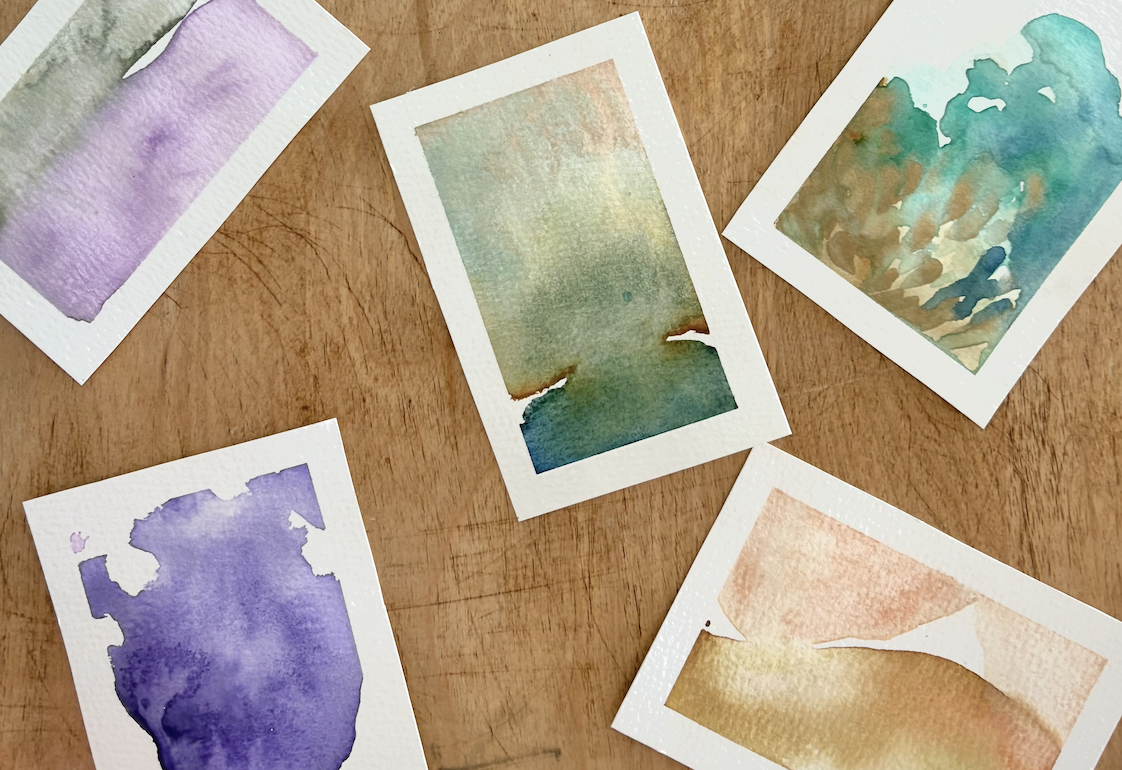
A Practice, Not a Product
This is the heart of what the Rooted Creativity: Art and Reflection Deck was designed to hold.
Many cards in the deck are invitations into embodied creativity: a gentle art-making prompt paired with a reflection question that turns your attention inward. Not toward what you made, but toward what you noticed while making it: what arose, what surprised you, what wanted to stay on the page and what, maybe, finally felt like it could be let go.
The deck asks for no special materials and no artistic background. It asks only that you bring your presence to the table, with enough curiosity to see what wants to happen next.
That, in itself, is the practice.
If you are new to this kind of creative exploration, you don’t need to begin with anything big or impressive. You can begin with making simple marks on a page and sensing what is present in your body and mind. That is where embodied creativity begins. And it’s enough.
—
Rooted Creativity is a therapeutic art and reflection deck for adults, designed by a registered psychotherapist and trained art therapist. It is not art therapy, and is not a substitute for psychotherapy. Learn more at rootedcreativity.ca.
